Two card players have hand strengths distributed independently & uniformly over [0, 1] and are playing for an existing pot of $100. Player 1 can check or bet $100. If Player 1 checks, the player with the stronger hand wins the pot. If Player 1 bets, Player 2 can call the bet or fold. Given both players are risk-neutralpaperclipexpectation maximizers, how does each play?
Showing posts with label MIT. Show all posts
Showing posts with label MIT. Show all posts
23 November 2019
A Taste of Quantitative Trading
Think you're interested in quantitative trading? Try your hand at this problem, courtesy of E6 Trading:


22 January 2016
Farewell, Athena account
[1] shewu@mass-toolpike> blanche ec-discuss -a shewu
blanche: Ticket expired while authenticating to Moira.
blanche: Authentication error while working on list ec-discuss
blanche: Try the -noauth flag if you don't need authentication.
[2] shewu@mass-toolpike> kinit
kinit: Clients credentials have been revoked while getting initial credentials
I thought I was clever by leaving my ssh session open overnight, during which the administrators almost certainly would deactivate my account. Today, I tried listing my files and was told "Permission denied."
25 December 2015
Trip Down Memory Lane
I got into building my own computers when Nvidia announced support for GPGPU on their G80 chipset (think GeForce 8800GTS/GTX/Ultra). Good times in 2008.
My one-upping started after this fellow rubbed his Core i7-920 in my Core 2 Quad Q9550's face. Game on! But really, I didn't have the funds or the knowledge to beat that.
Then a good friend Bayley showed up at MIT, and things got serious reasonably fast. In particular, my upgrade path looked something like this:
*
There's also a GPU story, which I shall not neglect. I went to MIT with my trusty aforementioned 8800GTS 320MB. A few swapfests later, Bayley wound up with a quartet of GTX 460s. It was mainly used for benchmarking Holy Balls, a demanding multi GPU raytracer, and got really toasty after a while. Good old Fermi.
The cryptocurrency scene started getting traction with the advent of profitable scrypt-coin mining. AMD cards were far superior in hashes/watt and competent in hashes/sec. Bayley got his hands on a few AMD 7850s, the preferred mining card, among other cards. I went extra long and got 11 cards from various sources (newegg, eBay, etc) since retailers caught on to the mining demand. Luckily I was able to dump my cards at cost (after eBay commission) after Mt. Gox blew and before everyone else wanted to dump their cards. Bayley kept mining, and even upgraded to 7950s as well as a 6990 when prices decreased and good deals appeared.
But wait, I'm back! I had the privilege of acquiring a new Mac Pro (affectionately known as the "trash can") with dual AMD D700 graphics cards. For all intents and purposes, they are two workstation grade cards (think neutered W9000s), each with 6GiB VRAM. So I can confidently say that I retake the GPU crown.
*
Meanwhile, with the abundance of swapfests at MIT, Bayley acquired multiple storage nodes for not too much money (and the networking infrastructure to back the system). To top that, he accidentally won half an SGI Altix and soon to be the glorious 1TiB of RAM on eBay.
*
GiB and TiB stand for Gibibytes and Tebibytes, because I'm anal and care about these distinctions.
My one-upping started after this fellow rubbed his Core i7-920 in my Core 2 Quad Q9550's face. Game on! But really, I didn't have the funds or the knowledge to beat that.
Then a good friend Bayley showed up at MIT, and things got serious reasonably fast. In particular, my upgrade path looked something like this:
- Core 2 Quad Q9550 4-core/8GiB DDR2
- Some Intel Xeon W35xx 4-core/24GiB DDR3
- 2x Intel Xeon X5650 6-core/24GiB DDR3
- 4x AMD Opteron 6164 HE 12-core/128GiB DDR3 ECC
Then Bayley and I both realized that we had to switch to rackable computers for any sort of ease in managing hardware. I took a break from single-image systems and built half a blade server:
- 2x Intel Xeon L5320 4-core/8GiB DDR2 FB-DIMM
While Bayley got a Sun Box®:
- 8x AMD Opteron ??? 4-core/128GiB DDR2 ECC
In a valiant attempt to dethrone me, he patched the Sun's BIOS with the microcode for hex-core CPUs, but the computer only recognized one core of one processor of the eight that he put it. Much wow.
My AMD box cemented 1st place in sheer awesomeness for student-owned computers for a little over a year, until Bayley discovered mainframes on eBay:
- Some IBM thing with 16x Intel Xeon E75xx 6-core/256GiB DDR2 ECC
Mind you, I have cemented awesomeness density, since my AMD box fits perfectly in 1U, while Bayley's monstrosity needs 16U, and a whole lot more power. :-) Not to mention that it blew a circuit breaker while trying to install Ubuntu…
Leave it to me, my worst enemy, to dethrone myself. I wanted to repackage the AMD box into a legitimate 1U chassis that I found on eBay for not too much money, since it had sat on a piece of cardboard (for insulation!) atop the dorm dresser. After the computer happily booted in the chassis, I jiggled one of the unscrewed heatsinks and shorted the motherboard. A nice spark flew from a voltage regulator to the copper heatsink and poof!
Leave it to me, my worst enemy, to dethrone myself. I wanted to repackage the AMD box into a legitimate 1U chassis that I found on eBay for not too much money, since it had sat on a piece of cardboard (for insulation!) atop the dorm dresser. After the computer happily booted in the chassis, I jiggled one of the unscrewed heatsinks and shorted the motherboard. A nice spark flew from a voltage regulator to the copper heatsink and poof!
gg no re Bayley
*
There's also a GPU story, which I shall not neglect. I went to MIT with my trusty aforementioned 8800GTS 320MB. A few swapfests later, Bayley wound up with a quartet of GTX 460s. It was mainly used for benchmarking Holy Balls, a demanding multi GPU raytracer, and got really toasty after a while. Good old Fermi.
The cryptocurrency scene started getting traction with the advent of profitable scrypt-coin mining. AMD cards were far superior in hashes/watt and competent in hashes/sec. Bayley got his hands on a few AMD 7850s, the preferred mining card, among other cards. I went extra long and got 11 cards from various sources (newegg, eBay, etc) since retailers caught on to the mining demand. Luckily I was able to dump my cards at cost (after eBay commission) after Mt. Gox blew and before everyone else wanted to dump their cards. Bayley kept mining, and even upgraded to 7950s as well as a 6990 when prices decreased and good deals appeared.
But wait, I'm back! I had the privilege of acquiring a new Mac Pro (affectionately known as the "trash can") with dual AMD D700 graphics cards. For all intents and purposes, they are two workstation grade cards (think neutered W9000s), each with 6GiB VRAM. So I can confidently say that I retake the GPU crown.
*
Meanwhile, with the abundance of swapfests at MIT, Bayley acquired multiple storage nodes for not too much money (and the networking infrastructure to back the system). To top that, he accidentally won half an SGI Altix and soon to be the glorious 1TiB of RAM on eBay.
*
GiB and TiB stand for Gibibytes and Tebibytes, because I'm anal and care about these distinctions.
29 October 2013
Costly Signaling: The Quest for a 90.0%
I remember that during my senior year of high school, there was some unofficial competition among friends to get the lowest final grade possible without ``Asian-failing." That is, to do as poorly as possible on graded assignments without getting the dreaded B+. The GPA cutoffs was set such that an A [93%, 100%] was a 4.0/4.0, A- [90%, 93%) was a 3.8/4.0, and B+ [87%, 90%) was a 3.3/4.0, so dropping from an A- to B+ is a much bigger deal than dropping from an A to A-. This game was certainly fun to play, but at that time I didn't understand the reasons that we participated.
It turns out that costly signaling could explain this phenomenon. Costly signaling, or the handicap principle, is a behavior that is costly for all groups, but more costly for the ``worse'' group than it is for the ``better'' group. In this case, better and worse are in terms of ability to do well in class and cost is the expected grade, which is related to the probability of sinking below 90% and the probability of being able to rescue a failure. I assume that the less smart kids have less control over their performance on assessments since they probably (1) can correctly answer fewer questions and (2) are more prone to make trivial errors.
Riskier variations include playing the game below senior year, during which grades are more valuable (since colleges will see them), or at MIT. I wonder how the brave souls at the Institvte would do, since the cliff between an A- (5.0/5.0) and a B+ (4.0/5.0) is massive.
It turns out that costly signaling could explain this phenomenon. Costly signaling, or the handicap principle, is a behavior that is costly for all groups, but more costly for the ``worse'' group than it is for the ``better'' group. In this case, better and worse are in terms of ability to do well in class and cost is the expected grade, which is related to the probability of sinking below 90% and the probability of being able to rescue a failure. I assume that the less smart kids have less control over their performance on assessments since they probably (1) can correctly answer fewer questions and (2) are more prone to make trivial errors.
Riskier variations include playing the game below senior year, during which grades are more valuable (since colleges will see them), or at MIT. I wonder how the brave souls at the Institvte would do, since the cliff between an A- (5.0/5.0) and a B+ (4.0/5.0) is massive.
28 October 2013
All I Do These Days
- Problem sets
- Ride planes and trains
- Code over the phone or on whiteboards
- Obsessively hit refresh on Autotrader.com
11 September 2012
New School Year, New Strategies?
I'm back at the MIT and junior year started off with a sizzle today. Having barely survived the past two years, I figured I should revise my various strategies in hopes for a more successful remaining two years. In no particular order:


- Digital handwritten notes: has a more similar tactile feel to writing on paper than typing on a keyboard, yet makes my notes more accessible for studying and saves organizational issues. Combined with taking iPad instead of my laptop wherever I go, this saves a considerable amount of weight.
- Make local git repositories for coding classes: just in case I accidentally my code in between.
- Run/Jumprope/DDR: sufficiently tires me out so I maintain my (sleep) schedule. Plus aerobic exercises burn way more calories than resistances ones.
Classes have been fine so far; it's only the fourth day, after all!
6.02 Intro to EECS II: This class is about compression and digital signals, with which I don't have much experience. It should be relatively straightforward since it's an intro class.
6.837 Graphics: This class is about all things computer graphics, from physics engines to modeling to ray tracing! It's also in C++, which is convenient, but could potentially be frustrating. Bummer that Fredo is not teaching it this term.
18.100C Intro to Analysis: This is a Death Class at the Institvte, which should definitely give me a run for my money. I haven't done math in quite some time, so it should be (refreshingly masochistic and) fun.
18.337/6.338 Parallel Scientific Computing: I'm pretty sure this class has already won my heart, if not for the material taught, but for our class [super]computer. We will be using a state of art 8-processor Sandy Bridge-E beast, with 80 cores and 1TiB of RAM! This baby will absolutely crush my SR-2 in (embarrassingly) parallel tasks, but I'm sure will lose miserably in single threaded tasks (that don't demand too much memory, of course). Hah.
21F.107 Chinese I Streamlined: This class is for people who have conversational skills but do not have much reading or writing proficiency. Hopefully all the memorization won't kill me.
Speaking of the SR-2, it is sadly out of commission until about next week because:
- I left the OS X boot flash drive at home (NJ), which is pretty unfortunate. I did put the aml file onto the disk, but that did not work.
The AMD 6870 that I was using is now sold to a friend.Well that's a non-issue now because my new GPU came in yesterday!!- Both plastic motherboard standoffs were broken during transport. I purchased some epoxy from Home Depot this past summer, but never got around to re-securing the mounts. I also need to cut the hole in the back for the IO ports, which I may get to this weekend.
Obligatory room pics.

My desk has turned into a parking lot. Name all the vehicles!

New GPU! It's an Nvidia GTX 460 2Win I bought on eBay. (oops camera rotate fail)

Steve Jobs is finally hung! (hanged?) Also the iMac makes an excellent timepiece.
26 July 2012
Two small lemmas
Two friends kindly pointed out to me that I will have power issues next year at MIT. Since most dorm rooms have one circuit (good for about 2kW), I can at most run two out of the following three items simultaneously: {computer, refrigerator, air conditioning}.
A friend suggested that I schedule all rendering and compute jobs late at night since the power grid will not be as hosed and to automate the modulation of my fridge/AC usage during the day. I also won't be helping the situation with a near-imminent upgrade to dual Nvidia GTX 580s, either.
28 June 2012
[NT] Learning and Life: a late mid, er, end-semester update
I haven't blogged about non-technical subjects in some time; in fact, readers have told me they couldn't understand what I was talking about in my previous few posts.
Classes have been going fine, well, not quite. I finally discovered my tolerance for code when I had four coding assignments (read: projects) due in a span of 27 hours. As much as I worked on them over spring break, I hit my breaking point come that period, so I ended up dropping a class. Luckily, it was only an elective.
6.005 Elements of Software Construction: On the surface, this is a relatively easy class for anyone with experience, except when you need to deal with the staff because a miscommunication resulted in automated testing disasters.
6.115 Microcomputer Laboratory (dropped): I walked in confident in my assembly skills, but as time went on, I got incredibly sick of writing assembly code. Who wouldn't? In addition, I found the labs to be incredibly contrived and boring. Luckily, I stayed in the class long enough to have learned a sufficient amount of EE approaches and skills for me to tackle decently nontrivial side projects.
6.815 Computational Photography: This class is incredible! You make sense of photography using mathematics and Fredo is an awesome professor :-) Sadly, my motivation for going to class is so that I can drool over his backpack of Canon L-lenses (read: expensive) since the assignments aren't too hard and lecture notes are posted. I really enjoyed the class because it isn't just pure coding; I had to work out the math of the algorithm to be implemented before I coded it up, which alleviates some of the pure-coding-related boredom.
18.06 Linear Algebra: This class solidified my fuzzy understanding of applied linear algebra. It was useful for understanding the algorithms in 6.815.
21W.789 Communicating with Mobile Technology: This HASS class is actually a programming class in disguise. Mobile apps aren't my forté, but it's still interesting to play with them, especially if you get credit for doing so :-) It's a three hour class that runs once a week in the evenings, but usually only runs for two hours.
The workload (erm, codeload?) about 600 lines of code a week (including 6.115; taking that out reduces it to approx 400), just for classes, sometimes more. Sometimes I feel that coding is dreadful.
At one point in the semester, I felt that I was losing focus -- especially in side projects, and thus getting extremely annoyed at myself. I think I had six or seven things I wanted to do, which is quite impossible given my time-constrained schedule. Thinking back to Steve Jobs' words:
I pared down that list to something more reasonable and stuck to it. I'm nearly done with the CAD of my scooter and the assembly of my scooter's hub motor. I am looking forward to finishing it before I leave campus. :-) Sadly, both NJ and NY outlaw electric vehicles (or registration of such vehicles is incredibly convoluted).
Another thing that's been really holding down my productivity was constantly worrying about my grades. Don't get me wrong; I realize grades are important, but recruiters only care so much, i.e. that you're not a miserable failure. In other words, think of it as a high-pass filter, with qualification on the y-axis and GPA on the x-axis. Once you hit a certain threshold, you're more or less fine in that respect.
After this term, I'll be halfway done with college. Incredible, isn't it? There's only two more years left! Goals (in roughly order of importance):
Porsche 911 Porsche Boxter (and then maybe a 911), the dream car I've always wanted as a kid. (Speaking of which, I've driven a 997 GTS, albeit for half a mile). But first, I need to learn how to drive a stick in order to appreciate operate the Porsche.
To those who have not experienced driving: there's a magical feeling when you're behind the 911 (or any comparable sports car). You have an immense amount of tactile feedback from the road from the steering. It's weighted quite a bit more than your average car, so it's easier to select a turning angle without overshooting. Then there's the engine, which is tuned to make a sweet roar while accelerating without accompanying white noise, but nearly nothing while idle. Here's a more concrete example:
It's also a shame that I'll be leaving so quickly, as I don't plan on staying in the greater Boston area or the east coast. I never had a constant home, a constant set of friends, or similar. Prior to coming to MIT, I've lived in six places. When I graduate and begin anew, I'll have lived on average 3.14 years per place, whereas many of my friends have just grown up in one area. I've grown accustomed to ever-changing aspects, such as meeting new friends, exploring new areas, and going through hardware relatively frequently, for better or for worse.
However, the one constant has been the venerated Hamburger, who has been by my side for eleven trusty years. He's traveled over 50,000 miles (I kid you not -- China and even the west coast are far away!) in planes, boats, trains, and of course cars.
Classes have been going fine, well, not quite. I finally discovered my tolerance for code when I had four coding assignments (read: projects) due in a span of 27 hours. As much as I worked on them over spring break, I hit my breaking point come that period, so I ended up dropping a class. Luckily, it was only an elective.
6.005 Elements of Software Construction: On the surface, this is a relatively easy class for anyone with experience, except when you need to deal with the staff because a miscommunication resulted in automated testing disasters.
6.115 Microcomputer Laboratory (dropped): I walked in confident in my assembly skills, but as time went on, I got incredibly sick of writing assembly code. Who wouldn't? In addition, I found the labs to be incredibly contrived and boring. Luckily, I stayed in the class long enough to have learned a sufficient amount of EE approaches and skills for me to tackle decently nontrivial side projects.
6.815 Computational Photography: This class is incredible! You make sense of photography using mathematics and Fredo is an awesome professor :-) Sadly, my motivation for going to class is so that I can drool over his backpack of Canon L-lenses (read: expensive) since the assignments aren't too hard and lecture notes are posted. I really enjoyed the class because it isn't just pure coding; I had to work out the math of the algorithm to be implemented before I coded it up, which alleviates some of the pure-coding-related boredom.
18.06 Linear Algebra: This class solidified my fuzzy understanding of applied linear algebra. It was useful for understanding the algorithms in 6.815.
21W.789 Communicating with Mobile Technology: This HASS class is actually a programming class in disguise. Mobile apps aren't my forté, but it's still interesting to play with them, especially if you get credit for doing so :-) It's a three hour class that runs once a week in the evenings, but usually only runs for two hours.
The workload (erm, codeload?) about 600 lines of code a week (including 6.115; taking that out reduces it to approx 400), just for classes, sometimes more. Sometimes I feel that coding is dreadful.
At one point in the semester, I felt that I was losing focus -- especially in side projects, and thus getting extremely annoyed at myself. I think I had six or seven things I wanted to do, which is quite impossible given my time-constrained schedule. Thinking back to Steve Jobs' words:
Focus is about saying no.
I pared down that list to something more reasonable and stuck to it. I'm nearly done with the CAD of my scooter and the assembly of my scooter's hub motor. I am looking forward to finishing it before I leave campus. :-) Sadly, both NJ and NY outlaw electric vehicles (or registration of such vehicles is incredibly convoluted).
Another thing that's been really holding down my productivity was constantly worrying about my grades. Don't get me wrong; I realize grades are important, but recruiters only care so much, i.e. that you're not a miserable failure. In other words, think of it as a high-pass filter, with qualification on the y-axis and GPA on the x-axis. Once you hit a certain threshold, you're more or less fine in that respect.
After this term, I'll be halfway done with college. Incredible, isn't it? There's only two more years left! Goals (in roughly order of importance):
- Acquire diploma
- Finish my scooter
- Build KawaiiKart
- Attend motorsports driving school (sadly, this is starting to seem unlikely)
To those who have not experienced driving: there's a magical feeling when you're behind the 911 (or any comparable sports car). You have an immense amount of tactile feedback from the road from the steering. It's weighted quite a bit more than your average car, so it's easier to select a turning angle without overshooting. Then there's the engine, which is tuned to make a sweet roar while accelerating without accompanying white noise, but nearly nothing while idle. Here's a more concrete example:
It's also a shame that I'll be leaving so quickly, as I don't plan on staying in the greater Boston area or the east coast. I never had a constant home, a constant set of friends, or similar. Prior to coming to MIT, I've lived in six places. When I graduate and begin anew, I'll have lived on average 3.14 years per place, whereas many of my friends have just grown up in one area. I've grown accustomed to ever-changing aspects, such as meeting new friends, exploring new areas, and going through hardware relatively frequently, for better or for worse.
However, the one constant has been the venerated Hamburger, who has been by my side for eleven trusty years. He's traveled over 50,000 miles (I kid you not -- China and even the west coast are far away!) in planes, boats, trains, and of course cars.
25 May 2012
Closure

Why hello there, Brass Rat.

Setup used to take the above photo.
Canon EOS 5D Mark II with Canon EF 100mm f/2.8L Macro and a remote trigger.
21 February 2012
IAP 2012 Recap
What I actually did:
- Run two phenomenal events (in one weekend, no less): Battlecode and Techfair. This really did take huge toll on me: for almost 75% of IAP, I felt that I had little to no time for myself because of all the work I needed to do and that every task was incredibly time-sensitive, which added even more stress. However, in the end, I really do have to say that they were worth every minute of early morning Java and sitting in SAO's office waiting for emails.
- Work out. I began my strenuous regime last IAP, having diligently gone to the Z center every morning to run and bicep curl. Unfortunately, I've gotten progressively lazier, so I worked out approximately three times each week. The upside was that I worked out with Jennifer, who taught me how to bench, squat, and deadlift, which turned out to be way shorter and more effective than my tedious routine! I'm extremely pleased at my results after one month.
- Move to BigRoom. Essentially I created a giant island in the middle of the room with two rows of desks against each other for maximum desk space for lab work and such. However, three monitors eat up quite a bit of space (and so does my uncased hackintosh).
- Mystery Hunt. This year's quest was lame because it was a giant mishmash of puzzles instead of having a unifying plot.
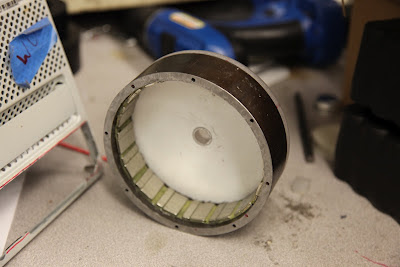
- Work on scooter. I finally re-ordered a bunch of parts, mainly for the hub motor, which is partially done, after the gruesome experience of creating a cancerous mixture of epoxy to secure the magnets onto the motor can. More on that in another post.
- Work on Power Mac G4 case mod. It's almost done! I'm serious! It just needs some blowing because I was a moron and didn't remove the motherboard when I was dremeling, which is now covered in tiny metallic shards.


What I didn't do:
- Power Mac G5 case mod. I'm surprised that my [lack of] self confidence is deterring me from mechanical projects since I'm extremely scared I'll make a mistake. It does make a nice base for my hackintosh, though.
- Finish projects. Ever since I read Steve Jobs (an incredible read, by the way), my standards for myself skyrocketed. Thus I now have an even harder time to deem a project finished, since it could always use some finer adjustments.
09 February 2012
Using git-svn (and vim) for 6.005
Hey everyone,
I figured that some of you might want to bypass eclipse and using a mouse and use something more user friendly, say, vim. Here's a basic outline of getting it to work on Mac/Linux:
- Install git-svn. Mac users, you'll probably want to get it from macports.
- cd to the dir in which you want the projects to be and run
git svn clone https://svn.csail.mit.edu/6.005/sp12/users/$USER/ps0replacing $USER with your athena handle (if your username is not the same as the same as your athena handle) and ps0 with the problem set you want
- run through the git-svn prompts. to sanity check: at some point, it should ask for your svn password.
You should be good to go!
As for JUnit tests, you need to first set the $CLASSPATH (preferably in your bashrc),
export CLASSPATH=$JUNIT_HOME/junit.jar:/myproject/classes:/myproject/lib/something.jarget the JUnit jar(s), and then run
java org.junit.runner.JUnitCore <test class name>Hope this helps!
Sources: http://junit.sourceforge.net/doc/faq/faq.htm#running_1
31 December 2011
Year in Review: 2011
Well, 2011 has been quite the year! I'm getting the hang of surviving at MIT, especially with my masochistic nature. Although IAP at the beginning of the year was miserable, the year progressively got better and climaxed in the summer. Sophomore year has been going well, although I didn't have much time to breathe this fall. With that said, I'd like to get a few thoughts off my head.
This summer has been incredible! If you're a seasoned reader or stalker of this blog, you probably know that I interned at Apple this summer. Initially, my primary motivation to go was to satisfy my inner Apple fangirl, but everything changed when I arrived. I thought life couldn't get any better when I got a day pass to Apple's annual developer conference. However, upon learning my boss was a car geek (and an amateur photographer), I thought I found heaven. We'd talk about all things (super)cars, computers, and cameras when we occasionally bumped into each other in the stairwell, and enjoyed thrilling rides on traffic-less highways in exotic supercars. It was an incredibly refreshing and uplifting experience coming from a year being surrounded with math nerds.
I've been increasingly going out of my comfort zone (read: my room) this semester. In particular, I've been hanging out at MITERS more than I did last year. I even attended this term's MEETERS, the semesterly project showcase, even though I had nothing to show. That concluded with a copter flying melee, comprising of a mini quadrotor, a massive quadrotor, and a unique trirotor. Speaking of that, I should upload the video in the near future.
In addition, I made an effort this semester to go out and shoot at least once a week, for about an hour. It sure is fun standing in the cold for an hour! (actually, no sarcasm intended) I've posted some shots on this blog; more can be found on my flickr.
In addition, I made an effort this semester to go out and shoot at least once a week, for about an hour. It sure is fun standing in the cold for an hour! (actually, no sarcasm intended) I've posted some shots on this blog; more can be found on my flickr.
I've also decided to double major in math, rather than EECS. Watch me officially declare Mechanical Engineering next year.
Here's to hoping 2012 is even better!
29 December 2011
Fall 2011 End of Term
This term has been incredibly busy and academically rigorous! Here's a brief recap of what I've been up to:
6.01 Intro to EECS I: This introductory class is based around writing Python code and building circuits for programmable robots. It covers a potpourri of topics from object oriented programming to Bayesian updates, but none in depth. The class also has standards: if you're not careful, you just might get a lower-than-expected grade.
6.828 Operating Systems: This rigorous semi-lab class is awesome for one (and only one) reason: building your very own operating system! I was not a fan of using a toy operating system to teach operating system concepts since I had very little background prior to taking the class, but the case studies covered in the second half of the class were cool. This class easily becomes a time sink: a small bug from a previous lab can add another ten hours of debugging to your time spent on the current lab.
15.279 Managerial Communication: This class teaches strategic communication using a variety of contrived exercises. Sadly, this class does discourages an appreciation for thoroughly researching and knowing subjects of importance.
15.437 Options and Futures: This class covers futures, options, and credit derivatives. The first two topics were hot, the last one was not. I also wish this class went more into modeling, but that's what 15.450 is for.
18.440 Probability and Random Variables: This class is basically Art of Problem Solving Intermediate Probability and Combinatorics. And random variables.
25 December 2011
IAP To-Do List
Hopefully this won't sprawl into a gigantic list like last year's:
- SCOOTER!: I have not a clue about how long this will take. Probably will consume my life, but that's okay.
- Work out: I'm hoping to go at least five days a week. 5hr/wk
- BattleCode infrastructure: This is actually mandatory, but my health (and scooter) comes first :P ~20hr/wk
- Power Mac G5 case mod / Hamburger rebuild: This is going to be EPIC! It's been about four years since my last build, so it's time for an all-out upgrade! I'm going to do a very faithful G5 mod to appease my inner Apple fangirl. I need to order that hex-core engineering sample and buy a few standoffs and screws at some point. 7hr/wk
- Power Mac G4 Cube case mod: I've already gutted the unit and dremeled the back to make way for the ports, so all that's left is mounting the motherboard and making a carrier for the second hard disk. 3hr/wk
- Holy Balls: The game I've been working on with my bestest friends at MIT <3 4hr/wk
- Move to BigRoom: I got a bigger room, so I'll need to move. 'Nuff said.
- Mystery hunt: MIT's annual puzzle hunt held on a weekend, starting on Friday.
18 November 2011


11 May 2011
Andrew Lo: What a boss
``If you have no interest in money or don't care about making money, talk to me after lecture and I'll fix that.'' --A. Lo
Andrew Lo, a renowned finance professor, talked about how we could use financial engineering to solve society's three biggest problems (cancer, global warming, and one more that I forgot). His plan is similar to what MIT did to win the Darpa Network Challenge: to incentivize people who give money to solve problems, essentially relying on human greed, which has always been and will continue to be a part of human nature. (Fear, another powerful tool, only works in the short term; if one is constantly afraid of something, then he is not capable of surviving.) Lo gave the following example:
Suppose that, for a pharmacutical, developing a drug for cancer cost $500M, had a cycle of 10 years, and a 5% success rate. A successful drug would make $2B a year. If we only invested in one pharm, then they would have a pitiful return. However, if we invested in forty pharms, then our probability of having at least one successful drug is 1-(1-0.05)^40, or 87%, which is much higher than 5%. We would then need $20B, which we can get from one-tenth of America families if each family contributes $2,000. We can further incentivize by deducting this amount from the family's tax.
This $20B we get from taking advantage of people's inherent greedy nature is supplemented by donations from the altruistic, which amounts to $25M. Of course, this is a very simple model, but if we learn to take advantage of greed and focus it like a giant laserbeam to benefit society, say curing cancer, then we are capable of achieving great things.
Edit: typo in math; 0.87 = 1-(1-0.05)^40, not 1-0.05^40.
Andrew Lo, a renowned finance professor, talked about how we could use financial engineering to solve society's three biggest problems (cancer, global warming, and one more that I forgot). His plan is similar to what MIT did to win the Darpa Network Challenge: to incentivize people who give money to solve problems, essentially relying on human greed, which has always been and will continue to be a part of human nature. (Fear, another powerful tool, only works in the short term; if one is constantly afraid of something, then he is not capable of surviving.) Lo gave the following example:
Suppose that, for a pharmacutical, developing a drug for cancer cost $500M, had a cycle of 10 years, and a 5% success rate. A successful drug would make $2B a year. If we only invested in one pharm, then they would have a pitiful return. However, if we invested in forty pharms, then our probability of having at least one successful drug is 1-(1-0.05)^40, or 87%, which is much higher than 5%. We would then need $20B, which we can get from one-tenth of America families if each family contributes $2,000. We can further incentivize by deducting this amount from the family's tax.
This $20B we get from taking advantage of people's inherent greedy nature is supplemented by donations from the altruistic, which amounts to $25M. Of course, this is a very simple model, but if we learn to take advantage of greed and focus it like a giant laserbeam to benefit society, say curing cancer, then we are capable of achieving great things.
Edit: typo in math; 0.87 = 1-(1-0.05)^40, not 1-0.05^40.
07 May 2011
End of term evaluation
It's the end of another term at MIT, which means that I'm very close to have finished freshman year! (all that's left is two finals and a problem set) The semester was quite a ride; I did not do as well as I had hoped, but in the end, I think I learned all the material the classes asked me to learn. Without further ado, here are my opinions on my classes this term:
15.401 Finance Theory I (MW8:30-10, F8:30-10): This class is mostly memorization based; one only needs basic mathematical skill and intuition to do well (of course, economical intuition is highly recommended). It's easy to lose points here and there because of silly mistakes and can cause one's grade to drop quite easily, in fact. However, this class is a great introduction to the world of quantitative finance. Professor Stephenson isn't the best lecturer, but he gets the point across well.
15.053 Optimization Methods of Management Science (MW2:30-4): This class is also memorization based; same thoughts as above. It's a good introduction to Linear Programming, optimization algorithms such as Dijkstra and Max-Flow/Min-Cut/Min-Cost, and NP-completeness (although referred to as "really hard problems" in class). Again, silly mistakes will kill you. Professor Orlin, a renowned researcher of flow, inserts humor into an otherwise basic ((and boring) course.
14.01 Principles of Microeconomics (MW1, F1): This class is more math based than I thought, after doing almost no calculus in its sibling, 14.02. Your grade is basically determined by how silly you are on tests. Professor Harris is quite eccentric, which makes his lectures worth attending.
6.004 Computational Structures (TR1, WF2): This class was a lot of fun (one gets to build a 32-bit RISC microprocessor! (except in software, boo)), except for the quizzes, which actually required studying. (wait, what kind of statement is this?!) Ward is a great lecturer and injects humor into his lectures. But please, STOP WITH THE COMIC SANS!!11!!1
6.046J/18.410J Design and Analysis of Algorithms (TR9:30-11, F3): This class is one of those "rites of passage" for any decent math/computer science nerd at MIT. It wasn't particularly fun; absolutely no implementation was required: the entire class was very mathematically rigorous and proof-based. The take-home was lots of fun; it's rewarding when you solve a (hard, not NP-hard :P) problem you haven't seen before. Professor Leiserson is a great lecturer and knows how to use humor, unlike Professor Moshkovitz, who does very intense and dry math-based proofs (and in turn, loses half the class).
All in all, classes weren't as fun as first semester, probably because there was no software coding involved (no, those 6.004 bits do not count). I was also less bored because I spent more time learning and reviewing the material for classes, so I think I did better grade-wise this term than last term. However, I was still sufficiently bored at times, suring which I could have spent extending class material, such as working out proofs or reading papers on Google Scholar instead of staring blankly at a wall. What's done is done; grades have basically been decided, and although I could have gotten more As, I don't regret my decisions because (1) what's done is done; regretting will only waste CPU cycles, and (2) I needed to experience how a typical "lazy student" did and learn to not take this path again. Here's to a more exciting and more academically successful term this fall!
15.401 Finance Theory I (MW8:30-10, F8:30-10): This class is mostly memorization based; one only needs basic mathematical skill and intuition to do well (of course, economical intuition is highly recommended). It's easy to lose points here and there because of silly mistakes and can cause one's grade to drop quite easily, in fact. However, this class is a great introduction to the world of quantitative finance. Professor Stephenson isn't the best lecturer, but he gets the point across well.
15.053 Optimization Methods of Management Science (MW2:30-4): This class is also memorization based; same thoughts as above. It's a good introduction to Linear Programming, optimization algorithms such as Dijkstra and Max-Flow/Min-Cut/Min-Cost, and NP-completeness (although referred to as "really hard problems" in class). Again, silly mistakes will kill you. Professor Orlin, a renowned researcher of flow, inserts humor into an otherwise basic ((and boring) course.
14.01 Principles of Microeconomics (MW1, F1): This class is more math based than I thought, after doing almost no calculus in its sibling, 14.02. Your grade is basically determined by how silly you are on tests. Professor Harris is quite eccentric, which makes his lectures worth attending.
6.004 Computational Structures (TR1, WF2): This class was a lot of fun (one gets to build a 32-bit RISC microprocessor! (except in software, boo)), except for the quizzes, which actually required studying. (wait, what kind of statement is this?!) Ward is a great lecturer and injects humor into his lectures. But please, STOP WITH THE COMIC SANS!!11!!1
6.046J/18.410J Design and Analysis of Algorithms (TR9:30-11, F3): This class is one of those "rites of passage" for any decent math/computer science nerd at MIT. It wasn't particularly fun; absolutely no implementation was required: the entire class was very mathematically rigorous and proof-based. The take-home was lots of fun; it's rewarding when you solve a (hard, not NP-hard :P) problem you haven't seen before. Professor Leiserson is a great lecturer and knows how to use humor, unlike Professor Moshkovitz, who does very intense and dry math-based proofs (and in turn, loses half the class).
All in all, classes weren't as fun as first semester, probably because there was no software coding involved (no, those 6.004 bits do not count). I was also less bored because I spent more time learning and reviewing the material for classes, so I think I did better grade-wise this term than last term. However, I was still sufficiently bored at times, suring which I could have spent extending class material, such as working out proofs or reading papers on Google Scholar instead of staring blankly at a wall. What's done is done; grades have basically been decided, and although I could have gotten more As, I don't regret my decisions because (1) what's done is done; regretting will only waste CPU cycles, and (2) I needed to experience how a typical "lazy student" did and learn to not take this path again. Here's to a more exciting and more academically successful term this fall!
20 April 2011
CPW 2011: From the other side
Everyone says CPdubs is a blast if you're a prefrosh, but does the fun wilt when one becomes a student at MIT?
Thursday:
Since we're students and the rigorous MIT calendar does not allow for ``holidays,'' I dutifully went to my classes, 6.046 (Algorithms), 6.004 (Computational Structures), and 15.053 (Optimization Methods). At the end of 15.053, I talked with Professor Orlin for a bit regarding these ``hard problems'' he mentioned in class. We got into a little bit of complexity theory talk, which was pretty cool. I might end up taking some TCS classes after all…
After class, I scootered around a bit and ran into two BCA prefrosh. This makes three as I had run into one during lunch. Then I chilled at the MITERS booth in Lobby 10 to help show off EE talent (and be obnoxious, of course). Since there was only an hour left before we had to clean up, I did not bring my case mod and hacked displays. Instead, we blasted (contemporary) dance-pop music (Friday included) using LOLriokart's 100W sound system. That sure got a lot of attention!
Friday was the big day. After 15.401 recitation (which only had 4 people show up), I went back to my room and slowly disassembled my desktop setup to carry to Lobby 10. I managed to haul my Power Mac G4 Quad and my two Apple Studio Displays after half an hour of hard work and assistance. At the booth, I plugged everything in and fired up unholyballs (for lack of a demo) and then switched to xlock since it looked flashier. Too bad I didn't have a newer graphics card to do real time ray tracing. I wasn't quite expecting my casemod and displays to get much attention since MITERS really isn't the place for these types of projects (or is it?), but to my delight a good number of people asked me about my setup. I even had someone ask me about my overclock!


Meanwhile, we continued blasting pop music from LOLriokart. Charles was not happy when we played Friday (for the $$n^{th}$$ time), but he approved of the cycling theme from Pokemon Red/Blue. I suggested to him to drive around LOLriokart while playing the song, which he did. He gave some prefrosh rides on LOLriokart and even taught one to ride SegFault! I still am deathly afraid of that thing, most likely because the person stands above the axle.

Later that evening was the MITERS build party. Quite a lot of prefrosh went and they got to see the facilities and us in our native habitat. They were all amazed by our Make-a-bot, a handmade 3D printer, printing a white naked woman (I say white not only to be factually correct, but also to emphasize the contrast with the black naked woman sitting atop the Make-a-bot). After a while, all the prefrosh left to attend other events. We then did the usual: drinking soda, winding hubmötters, and burning vegetables with Bayley's incomplete and probably defective SLR.


I went back to MITERS on Saturday to finish winding my hubmötter. I was surprised and happy to see a prefrosh building a circuit! He was working on a little thing that had a POT to change the frequency with which an LED blinked (controlled by a 555, of course). After getting distracted by many things, I finished winding my hubmötter! Time to buy magnets and finish my electric scooter =)


Thursday:
Since we're students and the rigorous MIT calendar does not allow for ``holidays,'' I dutifully went to my classes, 6.046 (Algorithms), 6.004 (Computational Structures), and 15.053 (Optimization Methods). At the end of 15.053, I talked with Professor Orlin for a bit regarding these ``hard problems'' he mentioned in class. We got into a little bit of complexity theory talk, which was pretty cool. I might end up taking some TCS classes after all…
After class, I scootered around a bit and ran into two BCA prefrosh. This makes three as I had run into one during lunch. Then I chilled at the MITERS booth in Lobby 10 to help show off EE talent (and be obnoxious, of course). Since there was only an hour left before we had to clean up, I did not bring my case mod and hacked displays. Instead, we blasted (contemporary) dance-pop music (Friday included) using LOLriokart's 100W sound system. That sure got a lot of attention!
Friday was the big day. After 15.401 recitation (which only had 4 people show up), I went back to my room and slowly disassembled my desktop setup to carry to Lobby 10. I managed to haul my Power Mac G4 Quad and my two Apple Studio Displays after half an hour of hard work and assistance. At the booth, I plugged everything in and fired up unholyballs (for lack of a demo) and then switched to xlock since it looked flashier. Too bad I didn't have a newer graphics card to do real time ray tracing. I wasn't quite expecting my casemod and displays to get much attention since MITERS really isn't the place for these types of projects (or is it?), but to my delight a good number of people asked me about my setup. I even had someone ask me about my overclock!


Meanwhile, we continued blasting pop music from LOLriokart. Charles was not happy when we played Friday (for the $$n^{th}$$ time), but he approved of the cycling theme from Pokemon Red/Blue. I suggested to him to drive around LOLriokart while playing the song, which he did. He gave some prefrosh rides on LOLriokart and even taught one to ride SegFault! I still am deathly afraid of that thing, most likely because the person stands above the axle.

Later that evening was the MITERS build party. Quite a lot of prefrosh went and they got to see the facilities and us in our native habitat. They were all amazed by our Make-a-bot, a handmade 3D printer, printing a white naked woman (I say white not only to be factually correct, but also to emphasize the contrast with the black naked woman sitting atop the Make-a-bot). After a while, all the prefrosh left to attend other events. We then did the usual: drinking soda, winding hubmötters, and burning vegetables with Bayley's incomplete and probably defective SLR.


I went back to MITERS on Saturday to finish winding my hubmötter. I was surprised and happy to see a prefrosh building a circuit! He was working on a little thing that had a POT to change the frequency with which an LED blinked (controlled by a 555, of course). After getting distracted by many things, I finished winding my hubmötter! Time to buy magnets and finish my electric scooter =)


13 February 2011
18 January 2011
IAP Goals…or not
After not being hosed (okay, maybe I was extremely tired after the last week of straight coding) first semester, I started planning out my IAP and came up with the following list of things to do:
- Learn 18.03
- Pokerbots
- TA 6.096
- Case mod the Quicksilver Power Mac G4 I found
- Direct USACO Feb11
- Pongmegrenades
- Port Pongmegrenades to Android, i.e. figure out drag and drop, besides other things
- Build an audio input/output switcher
- Speed up the raytracer
- Add some more shortcuts and features to EvilWM
- Facebook Hacker Cup
- Techfair chores, etc.
- …and possibly a bit of bridge
- Learn 18.03: I'm almost there! Just 1/5 of the material left…chug chug chug choo choo!
- Pokerbots: I'm not exactly obligated to do it, but it seems worth it.
- TA 6.096: I'm obligated to do this.
- Case mod the Quicksilver Power Mac G4 I found: I went to Home Depot to buy plexiglass and cut out the old IO port sections…does that count as nontrivial progress? Dremelling was fun (and very sparky) though =D
- Direct USACO Feb11: Not an obligation, but it'd be cool to contribute to each of the monthly contests =D
- Pongmegrenades: I got sound to work (by virtue of copy & pasting code…does that count?
Port Pongmegrenades to Android, i.e. figure out drag and drop, besides other things:Not enough time T_TBuild an audio input/output switcher:The bus switch that engadget mentioned on its AV switcher is no longer stocked by DigiKey :( I got all the other parts from MITERS, though.Speed up the raytracer:Uhhh about that…Add some more shortcuts and features to EvilWM:About that too…- Facebook Hacker Cup: Dunno if Facebook will get its act together
- Techfair chores, etc.: I'm obligated to do this.
- …and possibly a bit of bridge: Bridge? Uhh…do I still know how to play?
Subscribe to:
Posts (Atom)